





Peace is a poem.


Cultivating resurrection in a crucified world.


Ways of grounding ourselves in our work.
How we ground ourselves in our work at JFI is sketched out below. This is the long-form version, a prolix invitation more than a crisp and polished sales pitch. It’s a prayer rope, not a handbill. The nuts and bolts are here if you want them.
We’ve tried to give words to what we value and wrestle with most, including the shores we’ve landed on after we’ve set sail and weathered the unpredictable seas for a good handful of years now. Peacemaking is emotionally enervating: despair lurks, grounded resilience is needed. It’s a sinuous path that’s never just plunked down in front of us — you make it wherever your foot eases into earth, where your soul touches soil. Mythopoetics at least as much as strategic analysis. Poetry has always been an act of resistance, lowering our pail into a darkened well to summon echoes of the divine dream for our shared healing. We believe that.
This is who we are and aspire to be, not to exclude anyone who doesn’t resonate, at least perfectly or completely. Everyone is welcome, as is healthy pushback. This isn’t set in stone; it’s a fugitive snapshot of coruscating treasures we hold with an open palm, words that will likely undergo revisions as we continue our pilgrimage down the path of peace and justice and notice what’s missing or downplayed.
What follows is a “living document.” Fire, not ashes. It will change — often without notice (check back regularly) — because life changes, our research changes, our feelings about things change, we change. These ways of grounding ourselves are a work in progress and an invitation to a deeper conversation. They aren’t exhaustive, and JFI doesn’t always embody them perfectly (try as we might … or when we forget to try). They reflect much of our curriculum, but more as the soil we cultivate for new life to break through the surface.
The values, lenses, approaches, ethos, and intended teloi of our professors at least rub up against these ways of grounding ourselves. Our polyvocal community adds new textures too, and “on earth as in heaven” doesn’t always look the same for everyone. So, we listen.
JFI is a conversation. We hope you’ll join in.
All drawings and sketches by Jim Forest.
// Menu


The disorienting and disruptive nonviolence of Jesus anchors what we do, so let's start there.
It’d be nice if we could enforce nonviolence, but then it wouldn’t be nonviolence — that ever-shifting tension between what is and what we want it to be. “Take your well-disciplined strengths, stretch them between the two great opposing poles,” says Rilke, “because inside human beings is where God learns.” The two poles of the tension are these: nonviolence is, for us, non-negotiable, but so is the inevitability of our failure. Already/not-yet. Between the poles of this tension is where Christ whom we follow is both human and divine, where we “live and move and have our being”; a string stretched, tightened just so, and plucked to make music, where we all reverberate inside the conversation, inside the 'betweenness.' It's a dance, not a mission statement.
It's a comforting failure that means our embrace of nonviolence can’t be absolutistic or calcified into an ideology, but is instead aspirational and telic — It's our travel companion, always a few steps ahead of us. It's Truth, yes, but our inner worlds can’t handle it all at once, and we don’t expect it to. As Hauerwas confesses, “I’m a pacifist because I’m a violent son of a bitch.”
01. Nonviolence is a sacred conviction in travail.


02. Jesus was nonviolent, but we don’t get to create him in our image.
Jesus lived nonviolently as a form of resistance in a world of empire and cultural decay, and we can show you how and why. We take this seriously. But that's not the main point. Nonviolence is nested in dynamic stories, not cold, stale legislation or ideology. Jesus as a nonviolent apocalyptic figure — revealing, unveiling, about who we are, about what we should want — is difficult to pin down because this act of revealing is meant to shake us out of our self-serving stupor that we'd rather preserve, and, if we’re attentive and honest, He does things we don’t like, we wouldn’t choose if we were him, regardless of our allegiances and priorities, left or right, progressive or conservative. This is as it should be; he is God and we are not ... yet.
INTERLUDE 1 | TENSIONS
HOVER —>

1. The double-edged sword of proximity when encountering the other, which is necessary for building relationships but, if the proper guidance is absent, can also reinforce false negative stereotypes that affirm what is perceived as inferior or odious in the other. 2. Related to tension 1 above, René Girard observed that conflict exists in the world not because we are so different, but because we are so similar, wherein these similarities become sources of rivalry and eventually scapegoating. 3. Embracing my own voluntary experience and absorption of injustice (e.g., “We will match your capacity to inflict suffering by our capacity to endure suffering.” —Martin Luther King, Jr.) as supported by simple living, humility, selflessness, relinquishment of my own rights or sense of fairness or safety, etc., while fighting for the alleviation of injustice, poverty, oppression, and suffering of others and caring about fairness and wholeness for them. 4. Seeking after and speaking truth that can be a way of identifying past harms so they can be addressed and repaired, but these can also fuel retribution if framed in careless ways. 5. Related to tension 4 above, human rights bestow dignity on all human beings and give access to the essentials of life, but they can become coercive if enforced on society or implemented using violence, while the violation of human rights can be a justification for retribution against the violators. 6. Our entanglement in systems and institutions of oppression, historical and ongoing injustices, colonialism, and industrialized consumer capitalism, yet speaking out against these even as we are entangled in and benefit from them. 7. Forgiveness for my benefit (relinquishing bitterness, not allowing my offender to hold that power over me) and forgiveness for the benefit of my offender (understanding that my offender isn’t ultimately culpable due to the myriad factors that led to the offence that can’t be controlled, the value and dignity of the offender, etc.). 8. The discomfort of the Cross’ demands on us: voluntarily turning the other cheek is sometimes thought to be an equalizing gesture by taking control of the situation from the offender (cf. Walter Wink) as a way to avoid “worm theology” or “doormat theology,” but does this also erode true humility, patience, etc. as exhibited in the Cross? 9. Is it our responsibility to “help” God usher in the Kingdom of God? Do we initiate this process at times or simply participate in what God is already doing? 10. Doing what works in peacemaking vs. doing what’s right. Is stepping into goodness enough without considering if it works? 11. Related to tension 10 above, focusing on results, which means that success or failure in peacemaking is ineluctably measured by whether or not we achieve these results, which can lead to despair and paralysis and eventually cynicism and apathy. 12. Should Christians not have any enemies, or will we always have enemies and this is precisely why we’re called to love them? Or are we simply not to be enemies of others even if others are enemies of us? 13. Should change in the form of peace and justice come about through revolution (quickly) or evolution (gradually)? 14. The value of non-dualistic thinking in contemplation that helps us to avoid judging if someone is in or out, good or bad, winner or loser, superior or inferior — all in black and white, cut and dry ways — but do we not also need to use our “judgment” to call out injustice? 15. Avoiding an us vs. them attitude while also choosing the side of the oppressed against the oppressors. 16. Nationalism, which is warmongering, imperialistic, and sacralized in the examples of the United States and Russia but is affirmed in the peace and justice world in the aspirations of Palestine, Ireland, and Indigenous First Nations. 17. Being invested in the world by working for peace and justice, while understanding that this world as it’s currently configured isn’t my final home and doesn’t ultimately satisfy my innermost longing — working for peace and justice while “just passing through” as salt, light, and resident aliens (cf. Stanley Hauerwas), which is itself a decolonizing attitude. 18. Being invested in the world by working for peace and justice, while affirming the value of fleeing this world if we want to disentangle ourselves from its oppressive, unjust, and violent systems and institutions and if we are fleeing towards a better representation of the kingdom of God. 19. How much to cooperate and collude with (and therefore in a sense also validate) the political authorities of this world when engaging in peace work. 20. The teaching of divine virtues such as patience, humility, etc. that’s easier for those living in a position of privilege compared to those who bear the direct brunt of relentless violence, oppression, and injustice and have no patience for patience and want peace now. 21. Emphasizing the inner transformation of a peacemaker and participating in peace work when we aren’t yet (or never will be) fully or completely transformed — When are we actually ready without the possibility of making things worse?

21 UNRESOLVABLE TENSIONS
OF PEACEMAKING

INTERLUDE 2 | WATER TO A GOLDFISH, SOIL TO THE ROOTS: THE OVERLOOKED CONSIDERATION IN PEACEBUILDING
The erosion of peace and justice is a lot of things for a lot of reasons, but ultimately this is a spiritual crisis due to cultural decay soaked in the principalities and powers.
Critiquing and dismantling the roots of injustice and violence is all well and good, but if we don’t address the composition of the soil that’s calibrated to the spread and thriving of these roots, we fail to recognize that we’re also buried and encased in this clay and we risk getting tangled up in these roots too — unwittingly becoming like them rather than starving them.
This is how and where interiority and exteriority mingle. A spiritual crisis with material repercussions. Human and divine.
This means we need to be both careful and courageous, nimble and bold — but most of all, attentive and intentional
02. ROOTS OF DESTRUCTION
Unveil, critique, and dismantle the oppressive institutions and systems that make us need healing.

01. BRANCHES AND BAD FRUIT
Identify and name the suffering, and triage the pain as a provisional but urgently necessary measure.
03. THE INVISIBLE SOIL
Interrogate the myths and idols of Modernity, refuse to get mixed up in them, and provide saner and more authentically human alternatives to the Machine by actualizing our prophetic imagination and ‘rewilding’ our faith and peace praxis.
03. Peace and justice means rewilding our sacred vocations.


We’re indebted to Martin Shaw for our reluctance to sanitize and tame the god-man who weeps when we "don't know the things that make for peace," refusing to reduce and distill Him into an impoverished and anemic caricature that just so happens to harmonize well with our tidy systems and checklist comebacks.
To gaze upon the “mossy face of Christ” can create discomfort, and we often see him only with our peripheral vision in a dark forest darting from tree to tree. Jesus as the Gardener in Gen. 3:8 and Jn. 20:15 exhibits a wildness as the median between feral and domesticated, unkempt and predictably organized. Gardens thrive on careful relationship — the back and forth between wildness and discipline of human and non-human nature — with either extreme severing this ancient connection through their parallel forms of power that take over and colonize. It's a coin flip. Both disrupt our restless gait down the pilgrim path towards becoming fully and truly human, fully and truly peacemakers.
Those things Jesus does and says that scandalize us or might not be “what I would do” generate unresolvable tensions and contradictions. We dare to "take the scriptures seriously enough to be disturbed by them," as Tish Harrison Warren describes Hauerwas' challenge to the church. Sometimes the best way to muffle our left-brain urge to smooth these over is, as Martin Shaw counsels, to just walk with them like a pebble in your shoe. Embrace this discomfort and let it teach you without succumbing to your default instinct to analyze, scrutinize, and rationalize it away.
How then do we become authentic peacemakers, salt, light, angels in the Machine when we’re asked to follow this improbable god-man?
It’s not easy, and it shouldn’t be. “The theologian’s task,” Hauerwas reminds us, “is to make it difficult to be a Christian.”

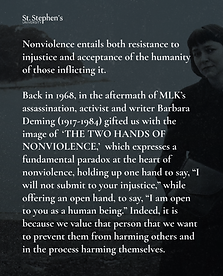
The two hands
of nonviolence
INTERLUDE 3




04. Loving your enemies is the sign of the Spirit.
Learning to love our enemies as a divine gift to which we become more receptive through a posture of contemplation and asceticism is core to who we are. Too often we want to skirt this commandment so much that we pretend we don’t know what an ‘enemy’ is or what ‘love’ is, conveniently defining both so we can go on hating ours.
St. Silouan the Athonite wrote, “We only know God to the extent that we love our enemies.” Personal enemies? Sure. In our families and others who are close to us? Yes. But also political enemies, people we think are undermining the world we wish it could be, the ‘other’ who (if we're honest) we'll only love once they become an exact reflection of myself, those who come on our property and steal our possessions (Heb. 10:34), and the divine image-bearers we kill on the battlefields of war. “It’s better to risk my life in order to love my enemy than to take someone else's life to defeat my enemy” (Search for Common Ground).
“If I cannot find the face of Jesus in the face of those whom I regard as enemies, if I cannot find him in the unbeautiful and damaged, if I cannot find him in those who have the ‘wrong ideas,’ if I cannot find him in the poor and the defeated and damaged, then how will I find him in bread and wine or in the life after death. If I do not reach out in this world to those with whom he has identified, why do I imagine that I will want to be with him, and them, in heaven? Why would I want to be for all eternity in the company of those I avoided every day of my life?” // Jim Forest
To say we love someone while harming them is an example of instrumental aggression within a mental framework of ego-syntonic rationalization. As St. James wrote, “Where do wars and fights come from among you? Do they not come from your desires for pleasure that war in your members?” (Js. 4:1).
Yes, James, they certainly do.
Is this hard? Why be a Christian if it wasn't?

05. Perissón | περ ισ σόν
“For I tell you, unless your righteousness exceeds that of the scribes and Pharisees, you will never enter the kingdom of heaven. … For if you love those who love you, what reward do you have? Do not even the tax-collectors do the same? And if you greet only your brothers and sisters, what more are you doing than others? Do not even the Gentiles do the same? Be perfect, therefore, as your heavenly Father is perfect” (Mt. 5:20, 46–48).
“Perfect” here is telios — the goal we aspire to and gradually move towards as the full maturity of who we actually are. Our ‘is-ness’ consummated. But how do we reach this target?
The Greek, perissón / περισσόν — “do more” — is the answer to the question, Why be a Christian at all? We “do more” by doing the hard thing rather than the easy urge, refusing to act like there’s nothing different about us when it truly matters. Anyone can pluck, steal, and control fruit from the Tree of the Knowledge of Good and Evil, but not everyone can become food offered to the world from the Tree of Life. As Wendell Berry remarked, “Rats and roaches live by competition under the laws of supply and demand; it is the privilege of human beings to live under the laws of justice and mercy."
By “doing more” than is expected — turning the other cheek, going the extra mile, loving and praying for our enemies, repaying evil with good, forgiving the seemingly unforgivable, welcoming the stranger rather than just our friends — this is power from below and within that siphons power from those who exert power from above. Why? Because when we respond to injustice through violence or rage, those who perpetrated the injustice are doing this to us — they’re the ones who are making us feel and act this way. They have the power over us. Perissón gives us agency through voluntary humility and makes us different from the world. Salt, light, yeast, Spirit. This is what seasons, illuminates, leavens, and breathes life into nonviolent peacemaking and reconciliation in an otherwise uninspiring, siloed, rectilinear world of the Machine in spiritual crisis. Perissón is the antidote to our worship of the idols of Modernity, the telos at the apex of the Beatific ladder from poverty of spirit to purity of heart as the prerequisite for becoming a peacemaker.

Dr. Andrew Phillip Klager is the founding Director of the Jim Forest Institute for Religion, Peace & Justice (JFI), as well as the Provost & Vice-Chancellor of St. Stephen's University (ssu.ca) and Professor of Religion and Peace Studies.
He has a PhD in Theology & Religious Studies from the University of Glasgow, where he studied the use of the Church Fathers by early leaders of the 16th-c. Anabaptist movement for their embrace of nonviolence and peacemaking.
Andrew’s research interests are in peace theology, the inner transformation of a peacemaker and becoming human, interreligious peacebuilding, conflict transformation and peacebuilding, Eastern Orthodox theology and spirituality, theological anthropology, Christology, patristics, St. Gregory of Nyssa, History of Christianity, and Anabaptist-Mennonite history and theology. He also has a deep appreciation for the way art, poetry, myth, and symbolism intersect with theology and contemplative peacemaking.


CLICK TO LISTEN


CLICK TO LISTEN


Who we are matters at least as much as what the world needs.
Summing up.
At JFI, we’re fond of picking our lane (or path) and sticking to it. Not “to keep us in line” or demean our expansive worth and value, but to keep us focused and sane — because we need to be who we are and not what we’re not, and give space for others to be who they are without us tramping on the unique bit of beauty and goodness they’re sowing in their earth. This is ultimately about discernment — or diakrisis, a spiritual sense of taste developed over time through experience — attentive to our unique giftings, what we're best equipped and positioned to do, and maybe even see what others don't and act on it.
This approach invites us to notice gaps to be filled, pay heed to and test our vocations with these gaps in view, and offer ourselves as gifts that build community with mutual dependence, collaboration, and support of one another instead of stepping on each other's toes — celebrate rather than confiscate. If we don't do what folks who follow us want us to do, you can at least be assured that we’re friends with those who do.
Peacemakers need a community in which we become a mosaic, parts of a whole, not feeling like we need to do everything when we're driven by ego, envy, anxiety, leading to overwhelm and burnout. Then, we're no good to anyone.
This is about depth more than breadth, so that others can receive what we offer and know we've put the work in. Make a covenant with limit, counsels Martin Shaw — When we've voluntarily penned ourselves in by what we've discerned is our unique calling, the only direction to go is deeper down where no one else has gone yet so we can resurface with peacebuilding treasures we might not have even imagined before such an excavation. Each of us should do this.

// Our lane...
01. THE INNER TRANSFORMATION OF A PEACEMAKER
Thomas Merton, Richard Rohr, and Dorothee Sölle guide us. The inner transformation of a peacemaker is paramount — courting our true selves deep within and the more spacious ontological capacity to love our enemies and live nonviolently intuitively by who we become rather than in a forced, contrived, and clinical way by simply what we think or want. “What we don’t transform, we transmit,” says Rohr.
Peace can’t be pushed with a piece of paper. It’s people at various stages of transformation who are responsible for putting what we write into practice. We nest peacemaking in contemplation and asceticism to resist burnout and the rage of the red-eyed activist, for resilience and cultivating the divine virtues of humility and patience, practicing silence and stillness to encourage the conditions for deeper listening, reflecting, discernment, attentiveness, nepsis — creating hospitable spaces that don’t impose our rushed words as premature points of reference that generate their own gravitational pull and monopolize the trajectory of an encounter before it begins.
The mystics and monastics are exemplars of nonviolence — disentangled as they are from the snares and idols of Modernity's industrialized consumer capitalist pseudo-culture that we in the world still benefit from. Our struggle is “not against enemies of flesh and blood .. but against the cosmic powers of this present darkness” (Eph. 6:12), against ego and control and “your desires that battle within you” (Js. 4:1) — this in the tradition of St. Aidan of Lindisfarne and The Bell and the Blackbird. “Becoming empty or 'letting go' of the ego, possession, and violence,” says Sölle, “is the precondition of the creativity of transforming action.”
02. THEOLOGY OF PEACE & JUSTICE
Our peace theology owes a lot to Walter Brueggemann, James Cone, and Stanley Hauerwas. The first task of the church is to be the church and to make the world the world — the church must be the cross-bearing, violence-renouncing, and Sermon on the Mount-embodying community that scandalizes the world by our radical love, and we must go out of our way to clearly identify the defining features of the world that invite critique and avoid them.
Our peace theology centres the already/not-yet upside-down kingdom of God as an invitational alternative to the misguided priorities and lower standards of the kingdoms of this world (Jn. 18:36). “The church doesn’t have a politics,” says Hauerwas, “the church is a politics.” We don’t seek to change the world but instead to be witnesses of the narrow way as a wide embrace that invites the world into a nonconformist community of resident aliens — To be rather than control, and to invite rather than coerce. Here, cruciform love is the kenotic aikido move — completely counterintuitive and foolishness to the world — that disorients onlookers until they fall into the arms of other-worldly divine Love.


03. GRASSROOTS PEACEBUILDING & CONFLICT TRANSFORMATION
The pioneering work of John Paul Lederach and Lisa Shirch shapes our curriculum. We’re attracted to grassroots peacebuilding and conflict transformation from the ground up in an invisible web of relationships using an elicitive approach of listening and learning from locals and Indigenous communities who have their finger on the pulse of the political, socio-economic, and cultural landscape better than anyone else. Both peacebuilding and peace activism form a symbiosis, shifting attitudes and systems that become the just conditions for peace to thrive.
Peace can’t be flattened into hashtags, slogans, or social media posts. These don’t dictate what’s important to us in the world of peace and justice. Peace is not just another consumer product to package and sell — It’s more holistic than this, more integrated, grounded, real. Sometimes trends harm the cause. Discernment — diakrisis — is needed. These words “have their place,” Jim Forest counsels, “but it’s secondary. … Like arrows, words point but they are not the target.” Or “We write with dirt under our fingernails,” as the Dark Mountain Manifesto puts it.
04. THE FACTOR OF RELIGION IN PEACE & VIOLENCE
We’re indebted to the scholarship and approaches of Marianne Moyaert, William Cavanaugh, and Marc Gopin. Maneuvering between and within the opposing poles of exclusivism and pluralism is the model of interreligious hospitality, making space for difference with respect that allows each to be themselves in the embrace of a generous curiosity. “Our job," says Merton, "is to love others without stopping to inquire whether or not they are worthy.”
At times, this means noticing how religion is used as a surrogate for deeper political, economic, social, and other grievances and injustices through the lenses of peace theology and strategic conflict transformation.
Whether in interreligious peacebuilding or multifaith encounters and dialogue, we discern how religion factors into peace and conflict by harnessing the values, teachings, practices, rituals, rhythms, and myths of all religious and spiritual traditions to cultivate peaceful human relationships and trust.


BRIAN McLAREN
AUTHOR, SPEAKER, ACTIVIST

When people tell me they're sick of organized religion, I gently suggest that maybe the problem isn't that religion is organized, but that it's organized for the wrong purposes. Then I'll often ask, 'What worthy purposes do you wish religious communities would organize around?' The Jim Forest Institute offers an essential answer to that question: working for peace and justice for everyone, beginning with the most vulnerable. I'm thankful that this community of scholars and learners are devoting themselves to a fresh vision of what religion is actually for.
Becoming a peacemaker is synonymous with becoming fully human.
"Man is mud whom God has commanded to become god." // St. Gregory of Nyssa
01
CRITIQUING MODERNITY AND REWILDING OUR FAITH AND PEACE PRAXIS
It's important to critique and dismantle institutions and systems of oppression — simply picking leaves or pruning branches still preserves the roots of destruction. “Though Jesus healed individuals," Rohr observes, "he critiqued the system that made them need healing.” But we think we can dig even deeper. These roots thrive because the soil allows — even encourages — them, and if we plunge ourselves in this same soil, who's to say our inner world and outer methods won't become what we oppose, osmosis by proximity? The peace and justice world rarely interrogates the idols of Modernity — water to a goldfish — individualism, the myth of progress, eschewing limits, ploughing through with an ‘advancements’ simply because we can without asking whether we should, the hyper value we place on utility and the measurability of our productiveness, rationalism, certainty, control, the fetishization of choice, autonomy and pseudo-freedom, industrialized consumer capitalism, quantity over quality, competition instead of community and collaboration, fast and efficient instead of slow and thoughtful, people as means, dis-integration, disenchantment with the natural world, rootlessness — loss of wonder, awe, marveling. “We swallow the moon, but we do not know our own hand.” If you’ve been in the peace and justice world long enough, you’ll know where we’re heading with this. Cultivating the just conditions for peace to flourish means dismantling the Machine and reacquainting ourselves with the soil of our souls. Decolonizing our faith and peace praxis doesn’t just mean pushback against the violence and oppression of imperialism, land confiscation and re-settlement, racism, economic exploitation, and cultural genocide and hegemony. This may be uncomfortable, but peacemakers would do well to interrogate the assumptions of Modernity that underpin both violence and injustice and our ill-conceived attempts at reversing this oppression. We’re stewing in this zeitgeist after all, so we’re bound to make mistakes that conform to it. What do we do? Tell better stories, as Paul Kingsnorth counsels us. Enter into a web of kinship with the natural world so that peace and justice envelopes all of creation, all intertwined and ineluctably interconnected, as our participation in the ongoing creation. “Prayer is infinite creation,” as St. Sophrony Sakharov experienced and observed. Situate peacemaking in indigeneity. Make a covenant with limit, as Martin Shaw brilliantly puts it. Dig deeper and unearth our roots. Eschew technique as “the totality of methods rationally arrived at and having absolute efficiency (for a given stage of development) in every field of human activity,” as Ellul famously defines it. Enthrone the right brain as the master and the left as its emissary so we can comprehend rather than simply apprehend, never confusing the map with the terrain. The stakes? “The next great division of the world,” Wendell Berry forewarned us, “will be between people who wish to live as creatures and people who wish to live as machines.”
02
EMPIRES OF THE MIND AND THE TYRANNY OF RESULTS
Modernity is obsessed with fixing and solving everything, measurable outcomes. We see the clever seduction of this and try not to be tricked by it. It colonizes our thinking and builds a paralyzing empire of tyrannical and hubristic expectations and despair in our fragile minds. Those who face relentless oppression desperately want results, and moderating our fixation on results can look like a luxury of privilege. We get that. We also get that well-intentioned peacemakers who aren’t directly affected by oppression can begin to care more about alleviating their own sadness than alleviating the suffering of the marginalized, disinherited, and vulnerable. But we also get that quick and dirty rarely arouses the outcomes we want. Good intentions aside, it’s possible our actions could make matters worse — “You may have to face the fact,” Merton counsels Jim Forest in the famous, ‘Letter to a Young Activist,’ that your work will be apparently worthless and even achieve no result at all, if not perhaps results opposite to what you expect.” How do we admit this without succumbing to apathy or cynicism? By also admitting that doing what’s right rather than what works isn't an inferior choice. “The basis for the ethics of the Sermon on the Mount,” Hauerwas urges, “is not what works but rather the way God is.” Sow goodness and beauty then. Focus on “the truth of the work itself,” as Merton again advises Jim Forest. A cross is failure by the usual standards of desired results, but it’s a “success” of Love. Bringing your bit of goodness into the world is itself a result regardless of whether there’s a result after the result. What happens to truth, goodness, and beauty once these stars dot a sky darkened by despair is up to the One who hung those stars. God has hands and ours are them, but we don’t build God’s kingdom “on earth as it is in heaven.” This is a response to a prayer. There’s a synergism. “The real hope is not in something we think we can do, but in God who is making something good out of it in some way we cannot see.” Why? Because “all the good that you will do will come not from you but from the fact that you have allowed yourself, in the obedience of faith, to be used by God’s love” (Merton again). How God seeps into the fissures and apertures created by the weight of the principalities and powers in this fractured world isn’t usually obvious to us, but we lean into the mystery of hope nonetheless — that most subversive posture in our age of near paralyzing despair and cynicism.
03
DO THE LITTLE THING RIGHT IN FRONT OF YOU
We must shield ourselves from the tyranny of results and the illusion that we can do it all. This is ego and desperation rolled into one, and “a bad tree cannot bear good fruit” (Mt. 7:18). Our vocation is often limited to what’s right in front of us. Like St. Thérèse of Lisieux, “The Little Flower” who, in her small, ordinary way, emanated beauty within her immediate realm of influence right where she was planted, peacemakers must think long term within an expanse of time that unfolds one small act at a time. When we accuse warmongers of trusting in their own strength and efforts rather than God, their bombs rather than divine Love, we need to heed this advice too. Sometimes we can be too Pelagian. We need to leave room for the Holy Spirit. Peace is incarnational, conceived in the womb of our groaning creation (Rom. 8:22). “Gradually you struggle less and less for an idea and more and more for specific people,” Merton observes, “The range tends to narrow down, but it gets much more real. In the end, it is the reality of personal relationships that saves everything.”
04
THE BEATING OF MY HEART IN A NIGHTMARE
We’re not meant to receive and absorb the glut of information that passes through our field of vision and pierces our hearts. It was never this way until the Modern era of neoliberal globalization and the (d)evolution of technologies that facilitate this oversaturation of information. We’ve gone from “town criers” in medieval villages and newspapers with limited stories read weekly in the general store of frontier towns to doom-scrolling livestreamed genocide on holstered screens the size of credit cards. We didn’t know what was happening a county away, never mind the next continent. The limits of time and space and the edge of our skin mean we can’t do anything with everything — We’ve been tricked into thinking we can hold it all, but, as Martin Shaw remarks, looking at a monster in the eyes for too long will reduce you to ashes. So, mythological wisdom tells us that it’s best to take up a shield and gaze upon the reflection of the monstrous events in our world. “No man can concentrate his attention upon evil, or even upon the idea of evil, and remain unaffected. To be more against the devil than for God is exceedingly dangerous. Every crusader is apt to go mad. He is haunted by the wickedness which he attributes to his enemies; it becomes in some sort a part of him.” // Aldus Huxley This isn’t apathy or cowardice. It’s how each of us plays to our strengths so that collectively we grow beauty in this world. But how do we do this in the peace world? Repent, for the kingdom of God is at hand? Here’s another way to put that: be transformed in your nous — “the deepest and truest self, the inner shrine to be entered only through sacrifice and death” — so you can move seamlessly into God’s dream for the world. Angels in the Machine. “The beating of my heart in a nightmare,” as Henry Edward Manning posits. This starts by taking inventory of how small we really are: we have one stomach, one pair of eyes and hands and legs, we occupy a small amount of space that extends only to the edge of our skin, and we can’t be in more than one place at the same time. Learning to rest in this reality is what compels us to rely on God, cultivates trust and faith, honours the decisions of his original creation. This is poverty of spirit. Our default consumerist mentality is the attempt to make ourselves bigger than we actually are — to expand our reach, inflate our egos, obnoxiously spread extensions of ourselves for everyone to see — because we want to forget our vulnerabilities, the wounds that open us up to anything that reminds us of our smallness and interdependence. We can’t each do everything, but we can collectively do a lot. “He who is everywhere is nowhere.” // Seneca But we need a common foundation, the culture — from the Latin, colere: “to dig” or “to till” — and ethos of the kingdom of God that gives the scaffolding to support the many peace and justice concerns, issues, and grievances out there, getting at the roots instead of treating the symptoms. Within this kingdom, don’t compare yourself to other peacemakers. Support and celebrate them. Do your bit, and cheer other peacemakers on when they do their bits. Don’t step on their toes. This is how community is formed. We intentionally don’t rush to be the first to say something about every politician, piece of oppressive legislation, injustice, or news event. There’s probably too much — or at least enough — of that already. As important as this type of engagement may be, it’s not our path. We can’t do it all, and we don’t try to. We instead focus on broader principles and values of peace and justice with less (though not entirely without) attention to specific applications. This gives space for our students and community to make these connections on their own — Remember Thurman: “Ask what makes you come alive, and go and do it.”
05
PILGRIMAGE TO THE OTHER SHORE OF GOD
Pilgrimage is a microcosm of peacemaking that uniquely creates space to cultivate a relationship with the unknown, to reflect and be transformed in our successive disappearances. The twists and turns of the pilgrimage and peacemaking path, what’s over the horizon, and the terrain you traverse and people you encounter, are all unknown to you. In both, we need to keep moving and expect surprises. Thich Nhat Hanh: “We arrive with every step” — in the present moment, not negating the past or future, but folding them into the present in life-giving ways that give it texture and momentum. Peace feels evasive and ambiguous — no one has experienced its fullness and wholeness in our postlapsarian arena. Each step in a pilgrimage embodies how the goal isn’t always “out there” far into the future but is right in front of us as one in a succession of countless “mini goals” within our reach. “The means are the ends in the process of becoming,” as Brian Zahnd puts it. The pilgrimage path is a cross. The narrow way we follow is bisected by the horizon further ahead, forming a cruciform way that’s superimposed on a landscape filled with uncertainty, discomfort, trepidation, monotony — but also expectancy and peace. This narrow way is the wide embrace, which is what makes it so narrow: a truly wide embrace is hard, and “only a few find it” (Mt. 7:14). The wide path that leads to destruction chooses between us or them and pits them against each other, but the narrow way embraces both us and them, expanding the invitation across differences. Pilgrimage means traversing foreign land as strangers and guests who invite the hospitality of locals. Very little is familiar, our instincts are blunted, and stories converge at intersecting junctures in our narratives the moment we meet. Relationship-building and trust-building are central in peacemaking, and pilgrimage dramatizes the sensation of arriving in foreign terrain, geographically or figuratively, not as colonizing settlers, but as exiled refugees who depend on both relationships and trust for survival. The common denominator here for pilgrimage and peacemaking is vulnerability — suspended between the safe havens of the beginning and end, open to the elements, embracing risk, and unmoored from our familiar routines. This reflects our interior pilgrimage too as we descend to our inner horizon, leaving the familiarity of our illusions about who we are — the layers of my false persona as the amalgam of the desires of others I imitate and that suffocate my true self deep within who I haven’t met yet. “My pilgrim’s progress,” remarks Carl Jung, “has been to climb down a thousand ladders until I could finally reach out a hand of friendship to the little clod of earth that I am.” And Thomas Merton: “The inner journey is the interpolation of the meaning and signs of the outer pilgrimage. One can have one without the other. It is best to have both.” Becoming conscious of our vulnerability amidst unfamiliarity, we experience echoes of the stories of our enemies — those we are called to love and help in their restoration, rather than harm. The encounter is transformative. No one survives a pilgrimage: the person who began will have gone away — is transformed into someone different, newer and older — when we arrive at the destination. This invites a generous curiosity, deep listening, a decolonized sense of “just passing through,” while also invested in the wellbeing of the earth and the other. Pilgrimage is a sort of exile and exodus, kicked out and liberated. You did something to defy power, and you were on the receiving end of someone freeing you. Not forcing yourself on others in an act of colonialism, pilgrimage is entering a strange land at the mercy of those who live there, hoping for hospitality and expecting to learn from others through “the crucifixion of our mind,” as St. Maximos the Confessor puts it. Pilgrimage and peacemaking are filled with tensions and paradoxes: ugliness (pain in your feet, inclement weather, sometimes fear) and beauty (the natural world around you — mountains, forests, rivers, beaches, seas). Our default impulse is to analyze, rationalize, harmonize, explain away, and find a resolution for these tensions — or choose one over the other — but this undermines mystery, paradox, tension, and the mythopoetic imagination. Pilgrimage trains peacemakers to pay attention. The rhythm of walking becomes an antiphonal liturgy with our two feet responding to each other’s movement, the predictable pattern we can come back to when our mind is entranced by distraction and we want to return to attentiveness. As we wrestle with the intrusion of our false selves or counterfeit personas, we need to learn this hard truth: we become what we give most of our attention to. Vigilance, decision making, thinking ahead without thinking too far ahead have currency in both pilgrimage and peacemaking.
06
UNTIL THE SHADOWS LENGTHEN — THE PASTORAL AND PROPHETIC
Aligning the pastoral with the prophetic is a pilgrim peacemaker’s long toil — the prophetic is the journey’s end, and the pastoral our halting gait. It is telic, the full maturation of God’s dream for our world that we awaken into — when “shadows lengthen and the evening comes.” The prophetic is the human articulation of the divine mind, what things should look like in their fullness “on earth as it is in heaven.” The pastoral is the step directly in front of you that propels you to the prophetic fullness. The pastoral is the creativity, the prophetic the creation. The pastoral is the ‘already,’ the prophetic the ‘not yet’ — It’s the whole of the Sermon on the Mount, the Beatitudes, the Magnificat, the fruits of the spirit, and the Isaiah scroll that Jesus read in the synagogue all rolled into one, and the pastoral is identifying the tiny ways we can do something that’s so damn hard. Pastoral is agile, oikonomic, sophia more than gnosis — the sails that set us on course to the other shore of God. When the prophetic fullness seems discouragingly elusive in its overwhelm, the pastoral reveals the possible as small, ordinary hope-filled acts. How hard it is shows how real it is — we’re not playing around here, catering to the idolatry of our flimsy, predictable default desires of comfort, wealth, and safety, trying to remake our messy, technicolour world into our own living room. While the prophetic shows us how imposing the holy mountain really is, the pastoral gives us hope that we can still climb it.
07
MORE THAN CONQUERERS — SITTING AT THE TERMINUS OF OPPRESSION
Fighting “not against enemies of flesh and blood ... but against the cosmic powers of this present darkness” (Eph. 6:12) is how we pick sides without pitting us against them. In the spiritual realm, the gloves are off. Our weapons? Prayer, contemplation, stillness, attentiveness, asceticism, good fruit, antiphonal kinship with God as the ground of our action in this postlapsarian arena. This is where Being and non-being collide, and when we’re on the side of Being in this cosmic battle, where we land in its worldly apparition is happenstance. Bothsides-ism doesn’t actually exist since it never truly includes ‘both sides’ — neutrality and convenient ambiguity with our words is automatically siding with the oppressor, not with both sides. The ‘us’ in this scenario has already identified a ‘them’ by their oppression of the weaker group. This isn’t our doing. Neutrality supports one side of an us-them dynamic that already exists. But if by ‘picking a side’ we mean choosing the oppressed if they want to harm or destroy the oppressor, we don’t do this either. Both options deepen the us-them division and enmity. This type of us vs. them-ing is the psychological prison that feeds the cycle of violence. But oppressors are oppressed in different ways than the oppression with which these same oppressors oppress the weak, vulnerable, and marginalized. The need for liberation from oppression doesn’t discriminate. “I knew as well as I knew anything,” Mandela reminds us, “that the oppressor must be liberated just as surely as the oppressed. A man who takes away another man's freedom is a prisoner of hatred, he is locked behind the bars of prejudice and narrow-mindedness.” Non-dualistic contemplation (theoria) mitigates against reductionistic and selective us vs. them-ing. Peace and justice work isn’t either/or — it’s both/and. We are all worthy of liberation and wholeness. But how do we concede this without abandoning the oppressed? We sit at the terminus of oppression with the oppressed who disrupt the cycle of oppression by refusing to return oppression with reciprocal oppression — absorbing rather than returning violence, the crucified world through whose suffering we cultivate resurrection. If sitting here means we find ourselves in one half of two sides, this is the serendipity of fighting “against the spiritual forces of evil in the heavenly places” (Eph. 6:12). Here, we’re also invited to lean into lament and solidarity — not an equal amount of solidarity and lament indiscriminately across the board: the size and decibels of our grief are commensurate with the mercilessness of the oppression. “Blood paid for peace but still those poor shall buy it.” // Robinson Jeffers
08
DWELLING IN THE LIMINALITY OF THE BORDERLANDS
The discomfort of making peace — getting squeezed, desert wandering — is dwelling in the borderlands between us and them, the liminal space between already/not-yet, the narrow path that separates the world that God loves and we should too, the weather that crosses political borders with ease so that the sun shines and rain falls on both the evil and the good (Mt. 5:45). This is, as David Whyte puts it, living in the conversational nature of reality, the incarnational space between past regrets and future worries. This isn’t just about mediation or diplomacy (though that’s part of it). Peacemakers need to hold it all, to see the whole as more than the sum of its parts. Compatible contradictions that no one else sees, comfort with paradox, tensions swelling over you without batting an eye. This is the pilgrimage on the path that divides people and groups, the quickly fleeting space between our many steps, the nearly imperceptible space between two breaths, the depth of darkness in the night between two days or the entrancing hues of dawn and dusk between night and day, and the thin places that rewild and enchant our imaginations as we traverse the natural world. These borderlands are where peacemaking happens — less defined than a razor-thin dividing line on a map that steals more territory for us from them. More porous and invitational, a frontier and threshold for encountering the other instead of a barrier for keeping them out. Not a political border viewed from above, but a margin on the edges of power where holy mischief-makers move about at eye level and embrace the outcasts. Here, we see the realities on the ground with real people, building relationships and embracing complexity, mutability, polyphony, and the erratic dynamism of these eclectic and elastic spaces.
09
MEETING UNDER THE OAK OF MAMRE
The stranger can elicit fear or curiosity, and a posture of hospitality — etymologically close to ‘hostility’ because of the temptation — maintains vulnerability without succumbing to fear that opens us up to curiosity. Hospitality too is a borderland between the change of two people in close proximity, where each is allowed to be themselves without threat of manipulation. The host-guest dynamic is integral to peacemaking, the wounds of each exposed, both vulnerable for different reasons. Between syncretism that erases and exclusivism that threatens is hospitality that welcomes, sets the table, and offers the gift of belonging. You can be yourself without changing others, and they can be themselves without changing you. Invitational and relational, neither foisting their identity on the other. Basics cared for, privations filled in, the space where universal human needs are fulfilled and that which is bland to one but sacred to the other is left intact at worst or becomes the locus of a generous curiosity when we’re at our best. This organizing principle and conceptual model of hospitality means we welcome all voices and friends who wish to enter the struggle in good faith. The concerns in peace and justice are complex, intertwined, subtle — even contradictory, real or seemingly. We need polyphonic perspectives to make sure we’re not missing anything, to honour the fullness of what’s needed when myopic and dualistic thinking — or thinking, usually not on purpose, with a particular emphasis or passion or preference — excludes perspectives worthy of our consideration. We need each other to complete our blind spots and remind us that we have only two eyes in one head looking out at walking icons.
10
BEYOND SPECTRUM DUALISM
Jesus was political but he’s no politician. He’s not selling snake oil, he’s preaching good news to the poor and setting captives free. He loves the polis — people — for God so loved the world. Brian Zahnd on the imperial leviathan in Canada’s basement: we don’t worship donkeys or elephants, but the Lamb slain from the foundation of the world. A lamb. Clearly, this is an upside-down kingdom, and citizenship here looks different — jarringly strange — compared to the expectations of campaign slogans, taxes, legislative assemblies, the DMV. We’re trying to be the ‘already’ of the already/not-yet kingdom, worshipping the Galilean shaman who enthroned himself on a Roman cross rather than a Roman solium. This is about allegiance, expectations, from where and whom we get our marching orders. Not the low standards and misguided priorities of empire. Ignore them. “Put not your trust in princes and sons of men in whom there is no salvation. When his breath departs, he returns to his earth; on that very day his plans perish” (Ps. 146:3–4). We wanted Saul as king, and God thought it was a bad idea. He eventually relented, but when he comes as “the image of the invisible God,” he’s trading the provisional for fullness — the way it should really be and really is. “My kingdom is not of this world,” Jesus clarifies. “If it were, my servants would fight” (Jn. 18:36). Kingdoms here rely on violence, not so the carpenter’s cross-bearers. Jesus is Lord, and Caesar is not. Three times Jesus refuses the temptation of political power during his forty days in the wilderness — we’re lucky if we can do it even once. Conservative and progressive both have their pitfalls, left or right — each can petrify into its own kind of fundamentalism, a sort of political purity culture. Chesterton: “The whole modern world has divided itself into Conservatives and Progressives. The business of Progressives is to go on making mistakes. The business of Conservatives is to prevent mistakes from being corrected.” The kingdom of God makes porous our political silos. Spectrum dualism and partisan politics divide us between false dichotomies. Two choices? Three? Four? Really — that’s all? Surely, God’s dream for the world is more subtle, solid, and transformative, “to be invited onto the terrible ground of beauty upon which our inevitable disappearance stands, to a voice that does not soothe falsely but touches the epicentre of our pain or articulates the essence of our loss, and then emancipates us into both life and death as an equal birthright.” // David Whyte That’s a more beautiful, life-giving, and human politics. Partisan politics can’t do what the church does better. Hauerwas: “The political task of Christians is to be the church rather than to transform the world.” That’s hard enough as it is. The gospels, summed up in the Sermon on the Mount and Beatitudes, call us to relentless, radical love for everyone equitably without exception simply because all of us are humans created in God’s image. Partisan politics can’t and doesn’t help us do this better. But it does potentially give us enticing reasons for showing less love for some people than others … which is exactly what happens. Partisan politics can never encourage us to love people more; it can only encourage us to love some people less. Compared to the Gospel, the only direction is down. “I think Christianity has often forgotten that it is a dream, to its own peril. When threaded to political power it often engenders the will rather than the wonder, the law almost entirely over the spirit. Christianity is a dream in which the very best of us is encouraged to emerge. A dream that challenges and inspires us. A dream in which God speaks directly to us.” // Martin Shaw
A philosophical framework for the weary peacemaker.


// DH Lawrence
APPROACHES
HOVER —>

“Beauty will save the world.” Peacemaking is creativity that participates with the Creator in what began in Eden, through the womb of the second Eve, to the fruit on the Tree of Life and in the Eucharistic chalice, planted in the ground from which the first and second Adams sprouted, cultivating resurrection in a crucified world. Creation of others, the world, and ourselves: “The poet turns inward to create. The contemplative turns to God to be created.” // Thomas Merton
It’s not just ornamental; it’s encounter as “aesthetic arrest” (James Joyce) “against which we have no defenses” (David Whyte) as inspiration and a template for the beauty we want to see and experience in the world. “Great art is the outward expression of an inner life in the artist, and this inner life will result in his personal vision of the world.” // Edward Hopper
Peacemaking is nested in the imagination of what our world could be, and we train for this by befriending wonder, the ability to marvel. “At the back of our brains, so to speak, there was a forgotten blaze or burst of astonishment at our own existence. The object of the artistic and spiritual life was to dig for this submerged sunrise of wonder.” // G. K. Chesterton
The visual arts, poetry, literature, music, dance, myth, storytelling are all affirmations of the sacramentality of the world against our impulse to destroy that which we can’t control or as a means of control. To create rather than destroy resuscitates hope in a weary world darkened by death.
“Thus every totalitarian regime is frightened of the artist. It is the vocation of the prophet to keep alive the ministry of imagination, to keep on conjuring and proposing futures alternative to the single one the king wants to urge as the only thinkable one.” // Walter Brueggemann

THE TERRIBLE GROUND OF BEAUTY:
ARTS & PEACEMAKING
The mantras “silence is violence” and “silence is complicity” are awkward for us. The inner transformation of a peacemaker thrives on silence. It’s easy for anyone who’s afraid of silence — afraid of sitting with just themselves as they really are — to shout these slogans. Not everyone who cares about peace and justice is our guide. But silence when you obviously should speak, that’s a different matter. Time and place. Not silence all the time. Not speaking all the time. But silence as stillness — the inner fortitude and stability needed for clear thinking and decisive action — that’s always there. Like preaching, peacemaking is more than speaking. “Few words, much love. To all. No matter who they are.” // Mother Gavrilia
Love and words, care and words, action and words do not automatically overlap. Silence isn’t always skirting responsibility or avoiding speaking truth to power. It can encourage the conditions for deeper listening, reflecting, discernment, attention — what Weil calls, “The rarest form of generosity.” This means creating hospitable spaces and the conditions for transformation for discerning injustice and what the next good thing we can do might be, while acknowledging that if we speak and act too quickly, too loudly, in the wrong places, with the wrong tone, at the wrong time, in reactionary ways that give oxygen and feed and platform that which we oppose, we might actually make matters worse.
Speaking to speak is impatience, and impatience is the seedbed of violence.
“If you want to know what speed is, it’s war. War is made necessary by the presumption that we don’t have the time to come to reconciliation, or to discover who the other is, that seems to be threatening us because we need to kill.” // Stanley Hauerwas. Also, “War is impatience.”

SUBVERSIVE SILENCE
We’re building peace, not just wanting peace — This requires agility, wisdom, and speaking truth to power in ways that make it less likely that we’ll lose our audience. This is the difference between peacemaking and peace advocacy, making peace instead of just aggressively wanting and screaming for peace out of a sense of frustration and desperation. There’s a unique sensitivity, talent, and sharpness to actually making peace out of the malformed clay of enmity, something that the higher decibels of our desire can’t reach.

MAKE PEACE /
WANT PEACE
DOROTHY DAY
FOUNDER OF THE CATHOLIC WORKER

"You just need to look at what the gospel asks and what war does. The Gospel asks that we feed the hungry, give drink to the thirsty, clothe the naked, welcome the homeless, visit the prisoner, and perform acts of mercy. War does all the opposite. It makes my neighbor hungry, thirsty, homeless, a prisoner and sick. The Gospel asks us to take up our cross. War asks us to lay the cross on others."

0–
STAY CONNECTED


